
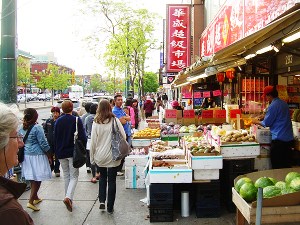
TORONTO – Seductive food aromas can floor a hungry person strolling Queen Street at dinner time or visiting the Spadina-Dundas neighborhood, one of four Chinatowns in this sprawling city.
Besides bringing a babel of tongues, they bring culinary habits that have turned their presence into a gourmet’s perfection. There are Vietnamese soup kitchens, Thai noodle houses, and plenty of places to gobble spring rolls, kimchi, biryani or rotis.
The huge St. Lawrence market is a good place to purchase musk ox rib eye steaks, ground venison, and prime camel boneless hip ($19.99/lb.) or strip loin of camel ($29.99/lb.).
From the first-nation peoples of Nunavut in the sub-Arctic wilds, to the newest arrivals at Toronto Pearson International Airport, Canada is a nation increasingly populated by hues of browns and yellows.
Still, it has distinct European communities – a Czech community, German delicatessens, a Greektown and Greek residents numbering around 100,000, a Hungarian community of about 50,000, a Ukrainian community of 100,000, an Italian community of more than 400,000, a Little Poland, and a Little Portugal.
Such diversity spills over into religion. The Jewish community here is said to number about 130,000 people.

 The Third Person